Christian Screen Time Alternatives: Turning Screen Time Into Scripture Time
Screen time is not going away.
Most Christian parents already know that.
The issue is not whether screens exist. The issue is what those screens are doing to the hearts, habits, and attention of our children.
For many families, this feels like a daily tension. You want to protect your kids. You want them outside, reading, praying, and talking with real people. You do not want every quiet moment filled with videos, games, or endless scrolling. But you also know that screens are part of modern life now. They show up at school, on long car rides, in waiting rooms, and at home after a long day.
That leaves many Christian parents asking the same questions:
- how much screen time is too much?
- should we ban games completely?
- are there any Christian screen time alternatives that are actually helpful?
- can screen time ever support Scripture memory for kids instead of competing with it?
Those are fair questions.
And for most families, the answer is not as simple as getting rid of every device.
The better question is this: can some screen time be redirected toward something that helps a child know God’s Word?
Christian parenting and screen time: the goal is not zero screens
Discussions about Christian parenting and screen time often swing between two extremes.
On one side, screens are treated like harmless background noise. On the other, parents feel pressure to remove every digital distraction from the house.
Most families live somewhere in the middle.
Children still need limits. They still need outdoor play, conversation, books, chores, family devotions, prayer, and church life. But they also live in a world where screens are normal. Trying to erase that reality entirely can create constant conflict without solving the deeper issue.
Technology is not automatically good or automatically bad. It can be used well or poorly.
A tablet can become a source of mindless distraction. It can also become one small part of a thoughtful family rhythm. A phone can pull attention away from what matters, or it can be used to play worship music, listen to Scripture, or reinforce Bible verse memorization.
The real question is not simply whether a child uses a screen.
It is what that screen is training the child to do.
A few minutes spent watching random content is very different from a few minutes spent reading, recognizing, and repeating Scripture. Not all screen time forms a child in the same way.
Why Bible games for kids appeal to the way children naturally learn
One reason screens are so powerful is that children naturally learn through repetition, reward, and play.
Parents see this all the time.
A child may struggle to remember one short Bible verse from Sunday school, then turn around and effortlessly name dozens of Pokemon characters. Another child may forget where shoes belong every single day, yet remember a long list of Minecraft recipes, YouTube creators, sports statistics, or every shortcut in a favorite racing game. Some can explain video game maps and character abilities with amazing detail after only a few rounds of play.
That does not mean children are incapable of learning what matters.
It means attention shapes memory.
When something is playful, interactive, and rewarding, children come back to it. When it feels like one more task after an already full day, they often resist it.
Many parents have felt the frustration of trying to help a child memorize a single verse while watching that same child effortlessly recall Minecraft crafting recipes or the names of every character in a game lineup. The problem is not always discipline. Sometimes it is the learning format.
That is one reason Bible games for kids, Bible learning games, and other Christian screen time alternatives can be worth considering. They work with the way many children already pay attention instead of fighting against it at every step.
Why Scripture memory for kids still matters today
Even in a digital world, Scripture memory for kids still matters deeply.
Christian parents have always wanted their children to carry God’s Word with them, not only on a church worksheet or in a Bible on a shelf, but in their minds and hearts.
“I have stored up your word in my heart, that I might not sin against you.” - Psalm 119:11
When children begin to remember Scripture, they are not merely collecting words.
They are becoming familiar with truth they can return to later.
Memorized verses can:
- shape how children think about God and themselves
- give them words to return to when they feel anxious, lonely, or discouraged
- help biblical truth stay close even when a Bible is not open in front of them
- remain with them long after a specific childhood routine has ended
Many adults can still recall Bible verses they learned early in life.
That is part of why Bible verse memorization remains so valuable. The words children repeat today may become the words the Holy Spirit brings back to mind years later.
The challenge is not deciding whether Scripture memory matters.
The challenge is building enough repetition into normal family life for those verses to stick.
Bible verse memorization usually grows slowly. A verse heard in family devotions, repeated on the drive to school, reinforced at church, and revisited in a Bible memory app may become familiar over time in a way that a single weekly reminder never could.
Christian screen time alternatives: what if some screen time became Scripture time?
For some families, a healthier goal is not trying to win every battle by subtraction.
It is finding wise ways to redeem part of a child’s digital routine.
That does not mean replacing Bible reading with an app.
It does not mean replacing family devotions, prayer, or church involvement with Christian games for kids.
And it certainly does not mean handing a child a phone and assuming spiritual growth will happen automatically.
It means using one familiar tool, the screen, for a better purpose.
Imagine a child spending a few minutes a day doing something more intentional:
- seeing a verse several times in a short session
- reading words from Scripture again and again
- recognizing familiar phrases faster over time
- building positive repetition around Bible memory instead of random content
Those small moments may not look dramatic.
But small repetitions are often how memory grows.
For many parents, that is the appeal of Christian screen time alternatives. They are not looking for a perfect digital solution. They are looking for better options than whatever the algorithm would put in front of their child next.
Bible memorization methods: why some children need a different approach
Flashcards still help many families.
So do handwritten verses, call-and-response repetition, memory songs, catechism practice, and church-based memory programs.
But not every child responds best to the same method.
Some children are happy to sit still and repeat a verse several times. Others lose focus almost immediately. Parents often notice that the same child who resists two minutes of flashcards can stay locked in on an interactive challenge much longer.
That does not automatically mean the game is better.
It does mean the child’s attention is being held in a different way.
For one child, repeating a verse from a paper card may work beautifully. For another, the verse may not begin to stick until there is movement, feedback, and a sense of challenge involved. A child who can remember every map detail in a favorite game or every stat on a sports team may simply need a different path into Scripture memory.
That is where a Bible memorization app or other Bible learning games can sometimes help. Not because older methods are wrong, but because some children need a format that captures attention long enough for repetition to do its work.
Why Bible learning games can help with Bible verse memorization
Games hold attention because they often provide things children respond to naturally:
- immediate feedback
- clear goals
- visible progress
- short repeatable rounds
- challenge without endless explanation
- repetition that does not feel exactly the same each time
Those same elements can support Bible verse memorization.
When a child interacts with Bible verses through short, repeatable gameplay, the repetition often feels less forced. Instead of only being told to review a verse again, the child has a reason to stay engaged long enough for the words to become familiar.
This is one reason Bible games for kids can sometimes succeed where more passive tools struggle. Good Bible learning games do not make Scripture less serious. They simply help some children stay with the verse long enough for real repetition to happen.
That repeated exposure is not a replacement for discipleship.
It is one practical way to support it.
Christian games for kids should support faith, not replace discipleship
This is where balance matters.
No Bible memory app can replace:
- reading the Bible together
- family devotions
- prayer
- church involvement
- patient Christian parenting over time
Christian parents already know that spiritual formation is deeper than any device.
But tools still matter.
Audio Bibles are tools. Picture books are tools. Scripture songs are tools. Printed verse cards are tools. Christian games for kids can be tools too, if they are used wisely.
The goal is not to find a magical app that does a parent’s job.
The goal is to use available tools intentionally.
That kind of nuance is important because technology can either serve what matters most or slowly crowd it out. It can help a child revisit Scripture, or it can keep a child in an endless loop of stimulation with nothing lasting to hold onto.
The question is not whether technology will shape your child.
It already does.
The question is whether some of that technology can be pointed toward what is true, lasting, and worth remembering.
A closer look at Verse Blitz as a Bible memory app for families
Verse Blitz was built around that exact tension.
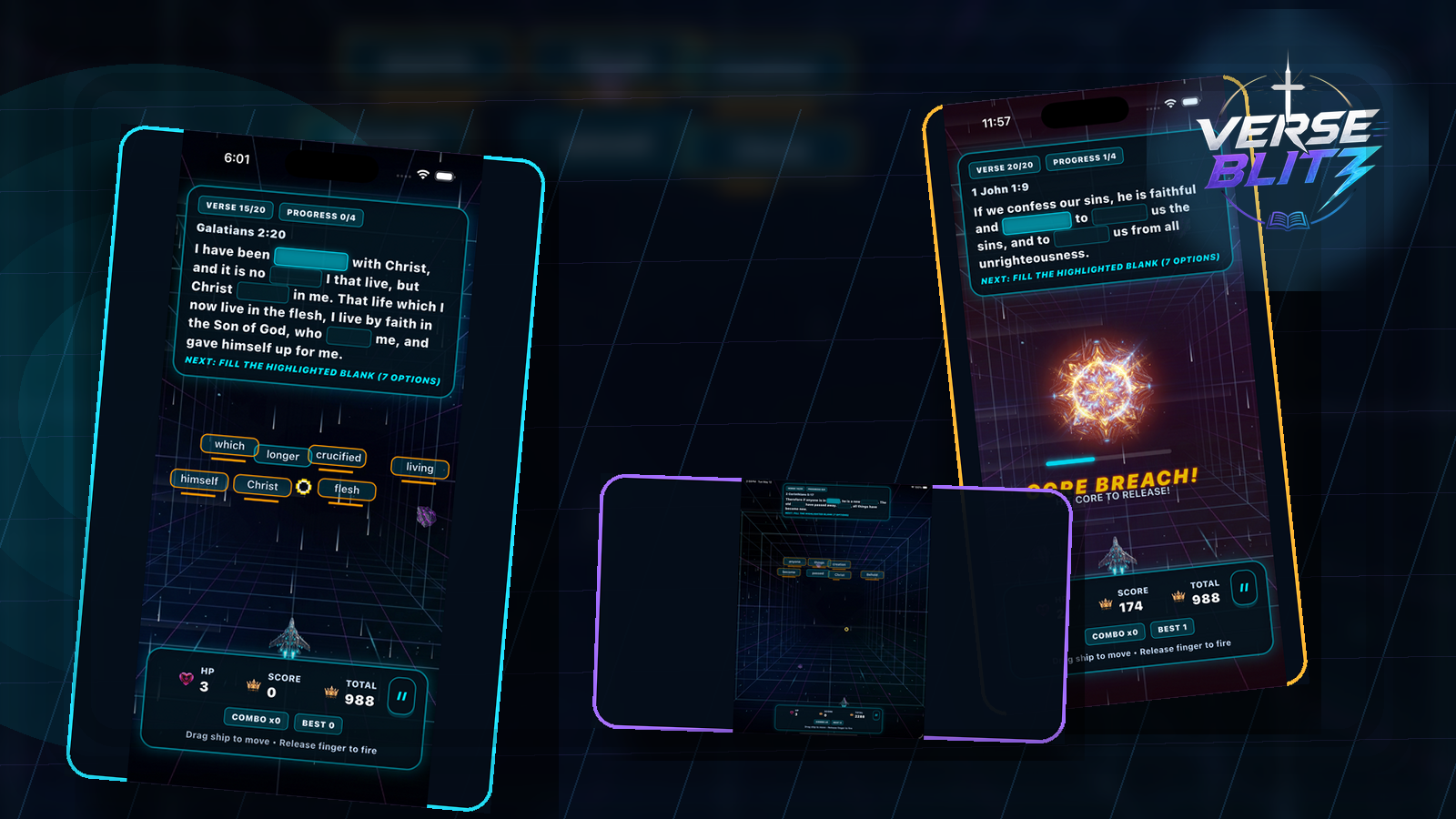
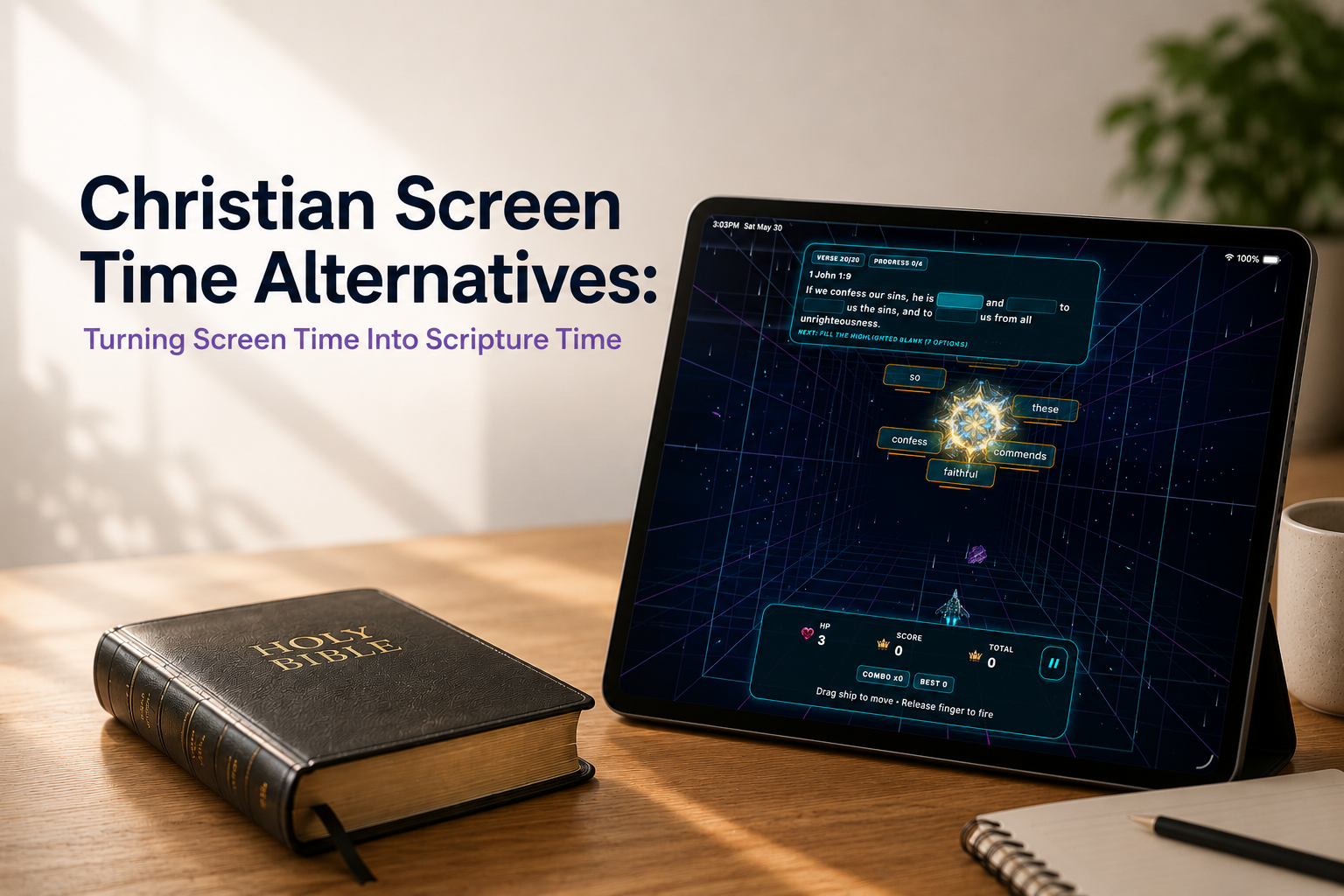
It is a Bible memory app designed to help players interact with Scripture through gameplay rather than only passive review. Instead of treating Bible verse memorization as something completely separate from screen time, it turns Bible verse practice into short arcade-style sessions built around recognition, repetition, and recall.
In practical terms, Verse Blitz gives players multiple Bible passages to learn through progressive memorization challenges. The app includes more than 150 Bible collections, drawing from both Old and New Testament verses, so children are not limited to one small set of familiar passages. That variety matters because different families may want to focus on different themes, situations, or parts of Scripture.
The gameplay is intentionally simple to return to. A child encounters verses repeatedly, responds to prompts, and moves through short rounds that reinforce recognition. The format is meant to feel active rather than passive. Instead of only glancing at a verse and moving on, players continue interacting with the words long enough for repetition to begin doing its work.
That does not guarantee memorization on its own.
But it does create a setting where Scripture memory for kids can happen more naturally for children who already respond well to games, momentum, and visible progress.
This is where Verse Blitz fits within the larger conversation about Bible games for kids and Christian games for kids. It is not trying to replace Bible reading, church, prayer, or family discipleship. It is trying to become one helpful tool among many.
For some families, that may matter most during small in-between moments. A few minutes before dinner. A car ride with a tablet. A quiet part of the afternoon when a child wants screen time anyway. If a Bible memorization app can turn even part of that time into Bible verse memorization instead of random digital noise, that is worth considering.
Verse Blitz will not be the right fit for every child.
Some children will still respond better to songs, printed cards, or simple repetition with a parent. But for families looking for Christian screen time alternatives, it may be a useful option because it brings together arcade-style gameplay, progressive challenges, and multiple Bible passages to learn without moving the focus away from Scripture itself.
In that sense, Verse Blitz is best understood not as a substitute for discipleship, but as one practical support for it.
Turning screen time into Scripture time, one small choice at a time
Many Christian parents feel like they are constantly playing defense in a digital world.
That feeling is understandable. There is a lot competing for a child’s attention.
But faithful parenting is often built through small, repeated choices.
If even a few minutes of screen time can become time spent seeing, hearing, and recalling Scripture, that is not a complete solution to the challenge of technology. But it is still meaningful.
Children may forget many of the videos they watch and many of the games they play.
They are far more likely to remember the verses that become familiar enough to settle into their hearts.
Most parents cannot eliminate screens completely.
But perhaps some of that screen time can be redirected toward something eternal.
That may mean reading a short passage together before bed. It may mean repeating one verse on the way to school. It may mean choosing Christian screen time alternatives, including a Bible memory app, that reinforce what your child is already hearing at home and at church.
Whatever form it takes, the goal is the same.
Not just less screen time.
Better screen time.
Not just quieter children.
Children whose minds are becoming familiar with God’s Word.
If you are trying to think wisely about Christian parenting and screen time, that may be one of the most practical questions to ask this week: how can we turn a small part of screen time into Scripture time?
And if a Bible memory app would help your family do that, Verse Blitz is one tool worth considering.
Frequently Asked Questions
Are Bible games good for children?
Bible games can be a helpful supplement to Bible reading, family devotions, and church involvement. They may help reinforce Scripture through repetition and engagement.
Can a Bible memory app replace reading the Bible?
No. Bible memory apps are best used as a tool to support Scripture memorization, not replace personal Bible reading or discipleship.
What are some Christian alternatives to screen time?
Family devotions, Bible reading, Christian books, outdoor activities, worship music, and Bible-based games are all options Christian families may consider.
How can parents turn screen time into Scripture time?
Parents can intentionally choose apps, content, and activities that encourage interaction with God’s Word rather than passive consumption.